


Sign up for a C&C Event
2029s
It is still early to fully evaluate the 2029 receiver class, as younger players are still adjusting to varsity speed and physically developing. Still, a few names have already flashed strong potential across both varsity and junior varsity action.
Martinsburg’s Jeremiah Brown has already shown the ability to impact the game in all three phases, demonstrating athleticism that translates beyond just offense. South Charleston’s Amari Valentine and Devin Lazo were forced into varsity roles early while the Black Eagles rebuilt their roster, and both showed promising growth as the season progressed. Each brings strong athletic traits and the ability to produce when given opportunities.
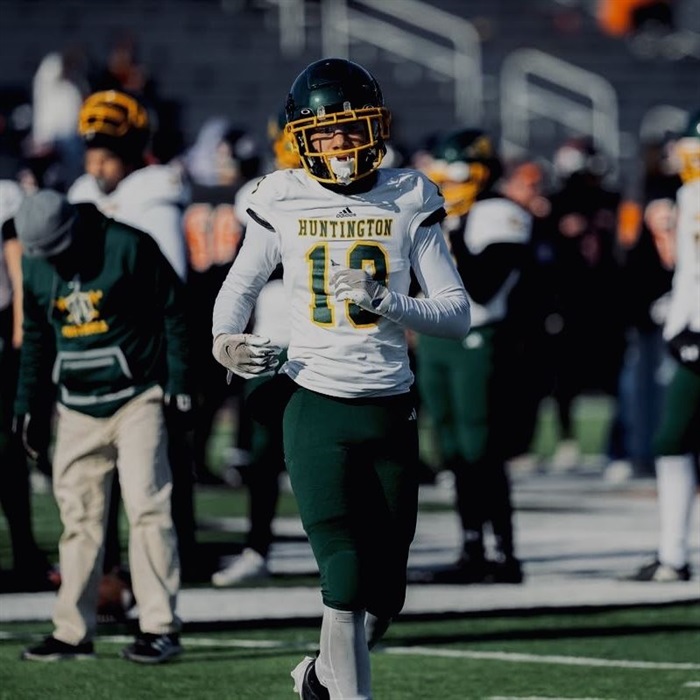
Huntington’s Kellen Rife also displayed intriguing upside and could see his development accelerated within one of the state’s most established programs. Wirt County’s Andrew Lemley and Spring Mills’ Blake Hoover also turned in highly productive debut seasons.
The early standout in the class is clearly KJ Viars of Independence. Already possessing good length for his age, Viars became a major contributor on a loaded offensive unit. What separates him right now is his maturity as a receiver—crisp routes, smooth separation, and reliable hands. He consistently makes plays without drops and looks like a player who could develop into a highly recruited offensive weapon over the next few seasons.
Deep Cuts
Several receivers have yet to produce eye-popping statistics but flash plenty of potential on film.
Point Pleasant’s Isaiah Waminam leads this group. Though slightly undersized, he consistently finds ways to create separation and shows the ability to go up and make contested catches. Martinsburg’s Ka’ilaokalani Villa saw more time defensively, but his size and athleticism make him an intriguing candidate to take a leap offensively.
Keyser’s Dominick Crawford brings perhaps the most obvious trait of the group: speed. Lining up at multiple spots, he consistently gets behind coverage and has the acceleration to turn those openings into long touchdowns.
University’s Branden Custer is another name buried within a talented receiving corps, yet he still found opportunities to flash his upside—making catches in space, forcing missed tackles, and showing traits that could lead to a larger role moving forward.
Promising
Junior year is often when receivers truly emerge. Physical development, improved timing with quarterbacks, and a deeper understanding of offensive systems tend to converge in a player’s third season.
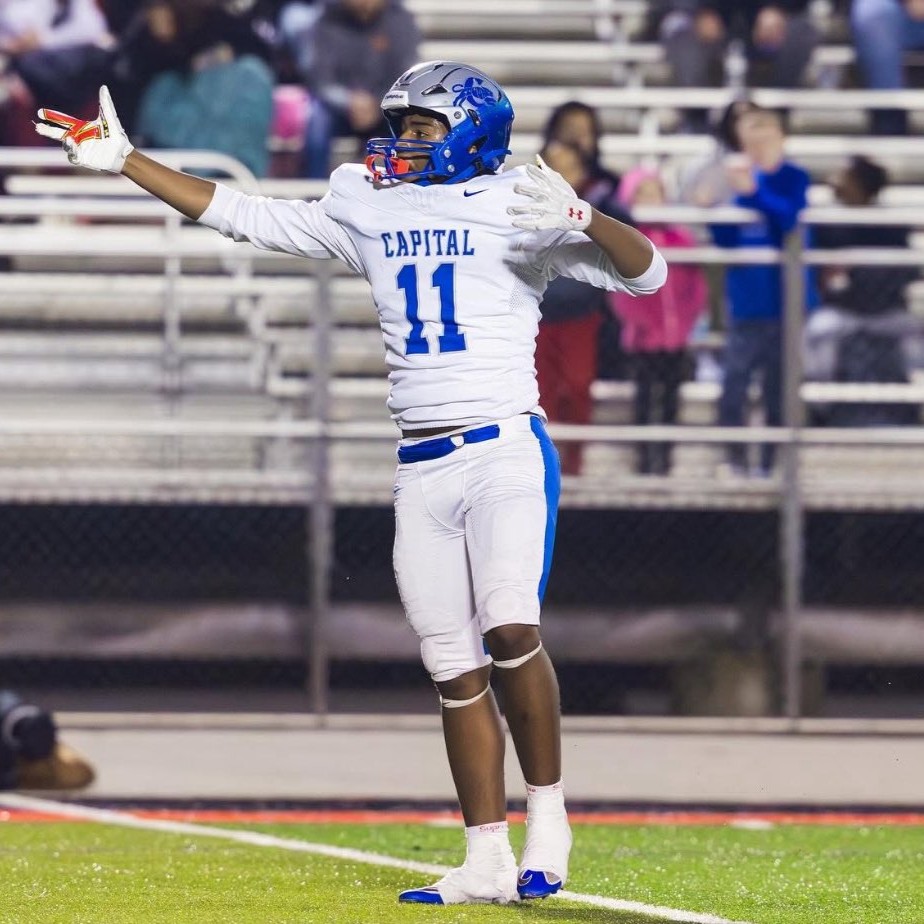
Turay Rush joins a loaded Herbert Hoover receiving corps after beginning his career at Capital. Even with competition for touches, his natural playmaking ability and instincts suggest he will carve out an impactful role.
Parkersburg’s Brady Thorn is best known for his defensive play, but his work at receiver deserves attention as well. Though slightly undersized, he has legitimate speed and has produced offensively since his freshman year in the state’s highest classification. A larger offensive role in 2026 could lead to a major statistical jump.
If production is the focus of the discussion, several other receivers deserve mention. Clay County’s Joey Elliott, Buffalo’s Caleb Cales, Ritchie County’s Jenner Keen, and Logan’s Zo Murphy all put up strong statistical seasons and were central to their teams’ passing attacks. Sherman’s duo of Chase Southern and Colby Atkins also cannot be overlooked, as both consistently produced and played key roles in the Tide’s offense throughout the season.
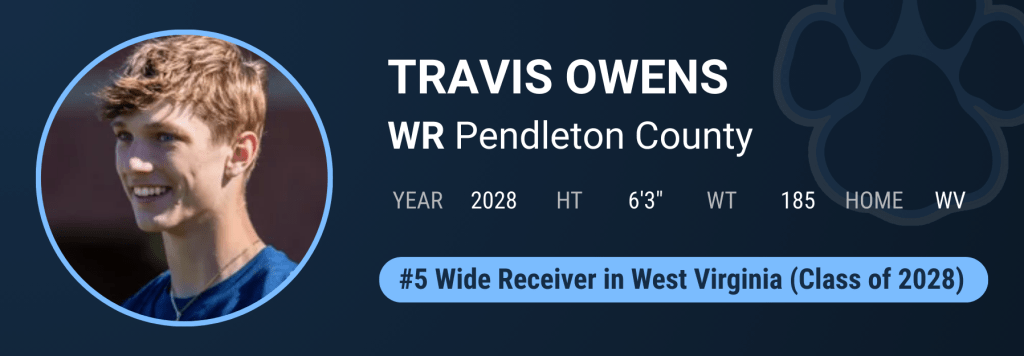
5. Travis Owens
Pendleton County’s Travis Owens was a major part of the Wildcats’ offensive success in 2025, finishing with 70 receptions for 1,315 yards and 18 touchdowns. While much of the attention went to the team’s quarterback play, Owens was the consistent target that made the passing game work.
Standing around 6-foot-3 and 185 pounds, Owens uses his length effectively to find soft spots in coverage and secure contested catches. Many of his receptions came in tight windows where he had to redirect his body or high-point the ball, traits that translate well to the next level. His basketball background is evident in his ability to track and elevate for passes. The challenge, as is often the case for small-school prospects, will simply be gaining enough exposure.
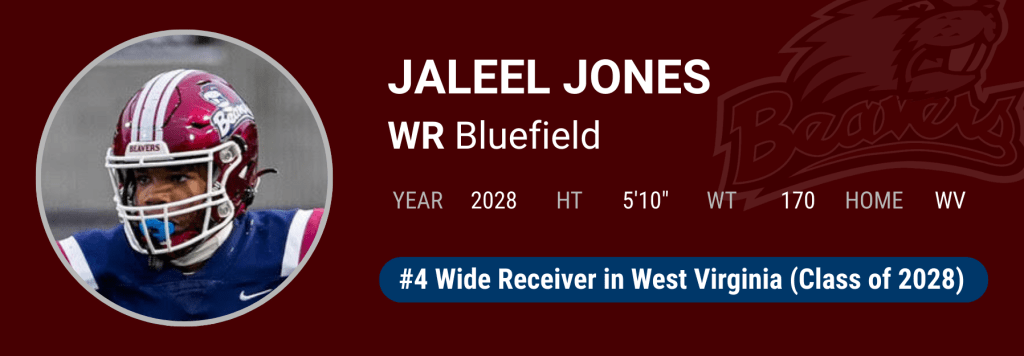
4. Jaleel Jones
Bluefield’s Jaleel Jones first gained statewide attention for his defensive play, earning the Carl Lee Award as a standout safety. However, his offensive film at receiver is equally intriguing.
At roughly 5-foot-10 and 170 pounds, Jones shows one of the more unique traits in the class: his ability to decelerate and change pace within routes. He naturally creates separation on hitches and in-breaking routes, making him a reliable underneath target. Once defenses begin to sit on those routes, he has enough deep speed to double-move past coverage and create explosive plays. His two-way versatility should attract interest at the next level.
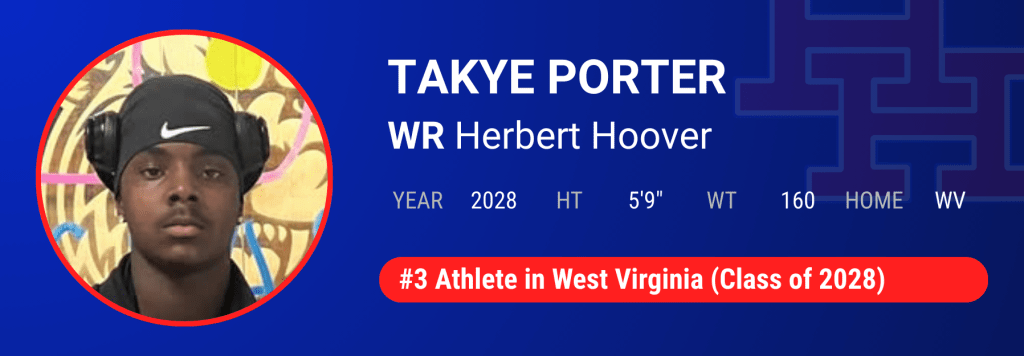
3. Takye Porter
Few players in the class bring the versatility of Takye Porter. The 5-foot-9, 160-pound athlete produced across multiple roles in 2025, rushing for 787 yards and 16 touchdowns, adding 313 receiving yards and four scores, and contributing more than 700 return yards with three touchdowns.
Though slightly undersized, Porter uses his low center of gravity and agility to his advantage. His cuts are extremely quick, and his burst allows him to separate from defenders once he reaches space. Whether lining up in the backfield, at receiver, or returning kicks, Porter consistently creates big plays. His all-around skill set suggests he could take over a versatile offensive role similar to previous Hoover playmakers.
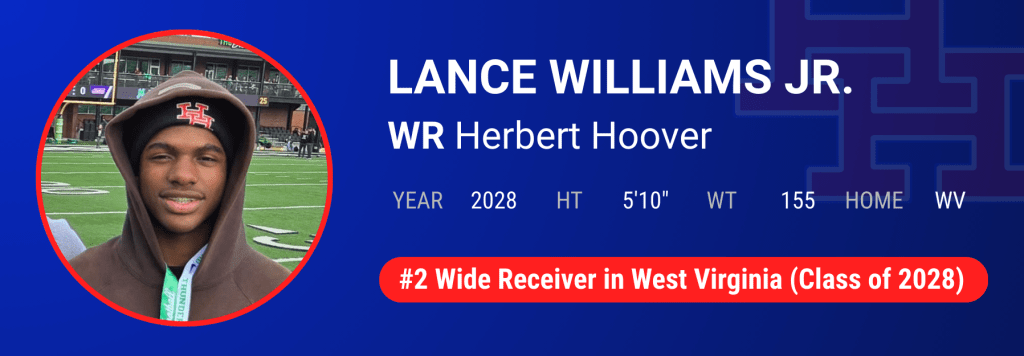
2. Lance Williams Jr.
Within Herbert Hoover’s loaded offense, Lance Williams Jr. still managed to carve out a major role. The 5-foot-10, 150-pound receiver finished with 35 receptions for 634 yards and 11 touchdowns while operating from multiple spots in the formation.
Williams’ game is defined by smoothness and reliability. He consistently runs routes with precise timing and positioning, traits that are often overlooked but incredibly valuable in structured offenses. Once the ball is in his hands, he shows strong playmaking ability—finding seams, making defenders miss, and turning short throws into explosive gains. His ability to execute the offense while adding yards after the catch will attract strong interest from the next level.
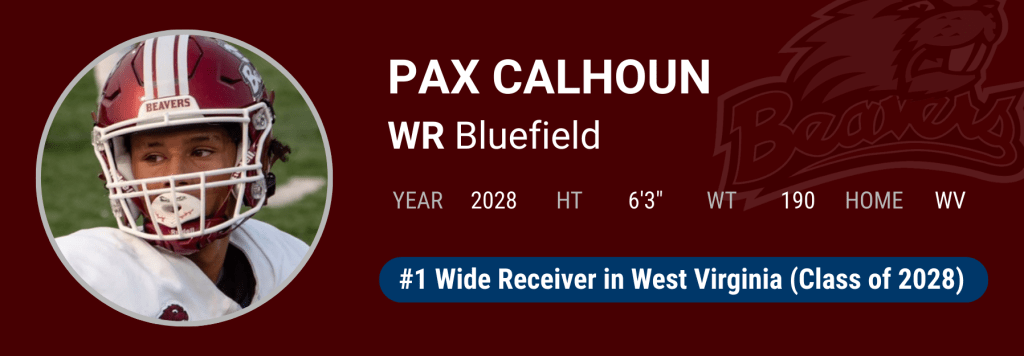
1. Pax Calhoun
Bluefield’s Pax Calhoun takes the top spot after a breakout season that made him a statewide name. The 6-foot-2, 190-pound receiver hauled in 72 receptions for 1,202 yards and 16 touchdowns as the primary target in one of the state’s most prolific offenses.
Calhoun’s size and length immediately stand out on film. He routinely lines up against smaller defensive backs and uses his frame effectively to create leverage and separation. While he does not rely purely on speed, his long stride allows him to glide past coverage once he gains a step. He also shows strong hands, attacking the ball and securing it quickly after the catch.
With his combination of size, production, and polish, Calhoun projects as one of the most attractive receiver prospects in the state. At minimum, he should draw strong Division II interest, with Division I programs likely to evaluate him depending on scheme fit.
RECRUIT THEM
Social media of players listed above, if found (ABC order):
Pax Calhoun — Bluefield (https://x.com/PaxCalhoun1)
Branden Custer — University (https://x.com/BrandenCuster12)
Dominik Crawford — Keyser (https://x.com/DominikCrawf)
Devin Lazo — South Charleston (https://x.com/devinlazo_)
Kellen Rife — Huntington (https://x.com/Kellen_rife)
Brady Thorn — Parkersburg (https://x.com/brady_thorn)
Amari Valentine — South Charleston (https://x.com/AmariValen55340)
Ka’ilaokalani Villa — Martinsburg (https://x.com/Ka_ilaVilla)
Isaiah Waminan — Point Pleasant (https://x.com/WaminanIsaiah)
Lance Williams Jr. — Herbert Hoover (https://x.com/LWjr304)